Release Notes
1. Version 2026.5.0
1.1. Main Server Changes
-
PERS-597- The description of published objects now displays images if the original capella model references workspace images in the rich text description. -
PERS-872- Add concept of Organization to better manage projects and teams.-
A default organization is automatically created if needed, and all existing projects, teams and accounts are assigned to it. The default organization name must be specified in the
application.propertiesthrough theperseus.default.org.nameproperty.
-
-
PERS-893- The scope of the 'server administrator' role has been reduced, to align with security best practices. This role is thus restricted to purely administrative features and does not grant access to published models anymore. -
PERS-892- It is now possible to assign several roles to a user.-
Consequently, the role 'server administrator' can now be assigned to standard user accounts, which makes it possible to deactivate the default
adminaccount after server set up completion. -
License tokens are automatically assigned to user accounts to align with their assigned roles, if a license token is available. This behavior can be deactivated.
-
-
PERS-876- Add a new tab in user settings to manage authorizations to communicate with third-party servers. -
PERS-878- Add expand/collapse button to model object rich text descriptions when they are large. -
PERS-925- Add support for batch publishing. -
PERS-926- The online project creation wizard has been improved, refer to the user guide for more details. -
PERS-929- The history is now global to a project and includes all the models published in this project. The data migration from the former 'per model' histories is automatic. -
PERS-930- A mechanism to automatically derive the Teams a user belongs to from OpenID Connect claims has been introduced. -
PERS-936- Panel visibility in the web UI can now be configured by the server administrator. -
PERS-937- For security reasons, 'Remember me' has been deactivated, so users must log in again after a configurable inactivity delay of 30 minutes by default. -
PERS-925- It is now possible to publish Capella models in batch. Refer to Batch Publishing for more details. -
PERS-932- Theperseus.license.auto.assign.read.on.loginhas been removed as this feature has been removed. -
PERS-970- Jama polling is now performed on behalf of the association creator instead of the project owner. -
PERS-971- The OpenID Connect provider name displayed in the Login page can now be customized.
1.2. Contributor Client Changes
-
PERS-597- Images referenced from Capella rich text are automatically published to the server so that the online description can display these images online. -
PERS-741- Automatically open web browser to login when performing a drag&drop or copy/paste if credentials have expired.
1.3. Minor Changes and Bug-Fixes
-
PERS-875- Trim URIs entered by users when declaring friend servers. -
PERS-874- Configurable OAuthConsumer parameterStyle (Fixes a regression of Polarion 2512 that broke compatibility between Polarion and Publication For Capella). -
PERS-931- Fix 'External Links' panel in online semantic browser: Link types can now be collapsed/expanded. -
PERS-939- Creating aLinkRangeobject in Team for Capella now uses the correct default value for the direction constraint.
2. Version 2025.10.2
This is a hot-fix release to resolve several issues described below and add the ability to customize the front-end with specific information as a hoverable label in the header.
2.1. Main Server Changes
-
PERS-899- It is now possible for the server administrator to customize the front-end to include specific information as a hoverable label in the header. Refer to Custom information extension for more details.
2.2. Minor Changes and Bug-Fixes
-
PERS-741- Drag & drop now triggers an OIDC login when needed. -
PERS-875- OAuth friends root services URLs are now trimmed to avoid issues. -
PERS-888- Installation documentation now references the right PostgreSQL version (PostgreSQL 15) -
PERS-901- A migration issue regarding history has been fixed. -
PERS-903- The server OWASP dependency has been upgraded to fix a CVE. -
PERS-915- The XML Stax parser has been configured to fix a CVE regarding XXE attacks. -
PERS-913- A publication issue with proxy objects has been fixed. -
PERS-902- Security improvement of CSP headers. -
PERS-897- The error when publishing a link which type is unknown by the server has been clarified. The publication of Team for Capella models has been fixed. -
PERS-911- Publishing a link to an artifact which type is unknown by the server now returns an explicit error. -
PERS-921- Diagram elements are now navigable even when previews ared disabled. -
PERS-922- An issue with the history view pagination has been fixed. -
PERS-924- Model object representation IDs now delimit model & model object IDs using a '~' instead of a '-' to avoid potential issues.
3. Version 2025.10.1
This is a hot-fix release to resolve an issue that prevents logins with non-alphanumeric characters from being used (plain user login or OIDC login).
3.1. Main Server Changes
-
PERS-885- Fix regression on logins with special characters. -
PERS-887- Fix incorrect warning that could appear on models on online link creation.
4. Version 2025.10.0
4.1. Main Server Changes
-
PERS-816- Publication for Capella is now compatible with Jama Connect™ by Jama Software. -
PERS-800- The End-User License Agreement (EULA) has been updated. -
PERS-795- The default property mappings configuration has been improved to support more types of Capella elements. Make sure you use the latest version of the fileconfig/prop-mappings.jsonin your deployment to benefit from these improvements. -
PERS-783- It is now possible to create baselines on any version of published models. -
PERS-784- Any version or baseline of published models can now be browsed online. In addition, hovering the history view on any commit displays a preview of the currently selected object, as it was in this commit.
4.2. Contributor Client Changes
-
PERS-781- URL patterns are now automatically created for each recognized friend server. This automation works for most standard configurations of: IBM DOORS Next, IBM Engineering Workflow Management, Polarion, Jira, Jama Connect. It is still possible to edit these configurations manually should the need arise.
4.3. Minor Changes and Bug-Fixes
-
PERS-847- The online semantic browser panel 'OSLC Links' has been renamed to 'External Links'. -
PERS-829- A bug has been fixed that prevented the publication result from being fetched by a user different from the one who initiated the publication. -
PERS-796- A bug that prevented the semantic browser from displaying properly online has been fixed. -
PERS-794- A bug that prevented moving artifacts in folders in the traceability model has been fixed. This makes it possible to easily reorganize the structure of artifacts imported in models by drag & drop or copy/paste. -
PERS-780- Associations created to Polarion projects are now automatically configured to keep the dialogs open after confirmation. -
PERS-777- A bug that caused 'Update publication result' to loop forever in case of invalid credentials has been fixed.
5. Version 2025.6.0
5.1. Server Changes
-
PERS-579- Publication For Capella is now officially compatible with Jira, via the add-on OSLC Connect for Jira by Sodius. -
PERS-743- Publication For Capella is now officially compatible with Confluence, via the add-on OSLC Connect for Confluence by Sodius. -
PERS-748- Rebase on latest Sirius-Web and Obeo Enterprise for Sirius. -
PERS-746- A leak of JDBC connections has been fixed. This bug could cause a freeze of the Publication website for up to 30 seconds. -
PERS-750- Add edge label in image maps. It is now possible to click on the labels of semantic edges (such as Functional or Component exchanges) in published diagrams to navigate to the associated semantic element. Diagrams must be republished, former diagrams will not exhibit this behavior. Edges that are not tied to a specific semantic element won’t have a clickable label. The labels of edge ends are not clickable either. -
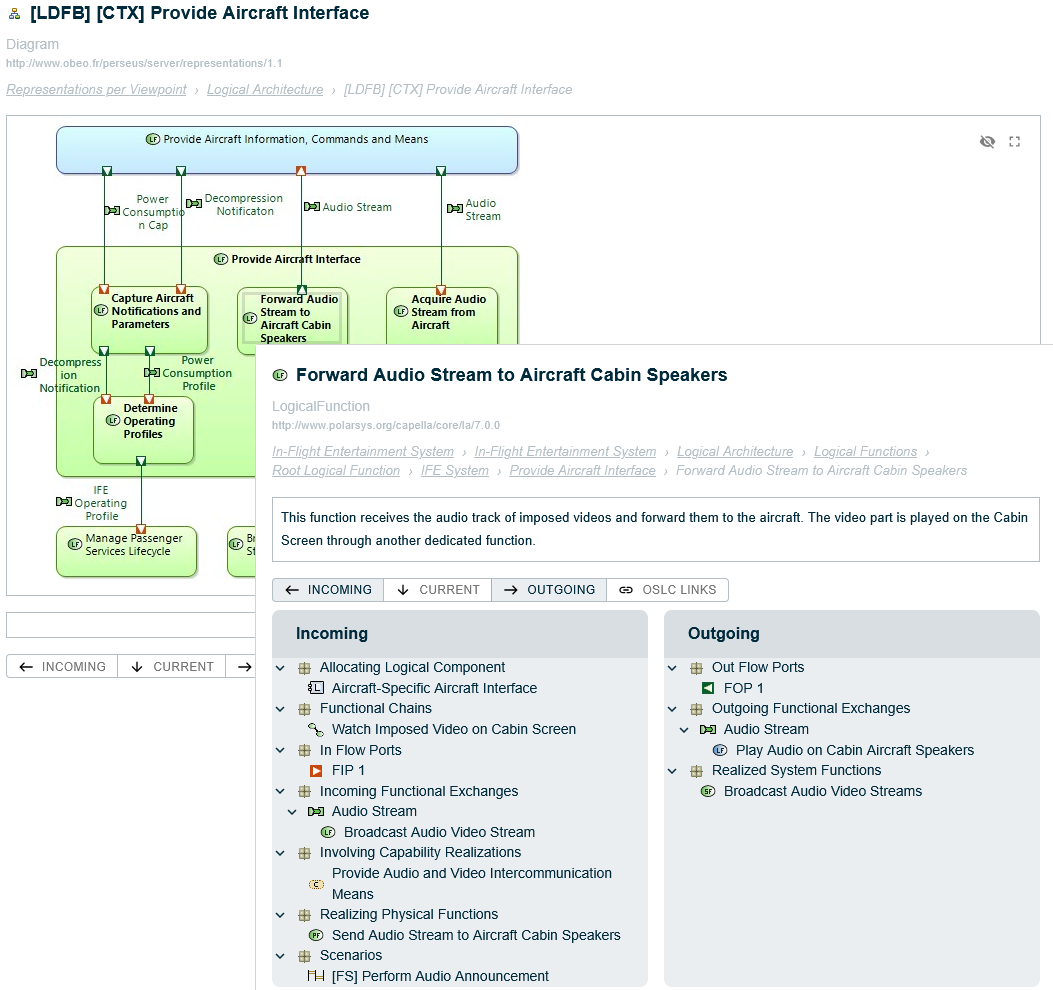
PERS-605- Add previews in diagram images. It is now possible to preview the elements of a diagram, either internal or external, by hovering them with the mouse.
-
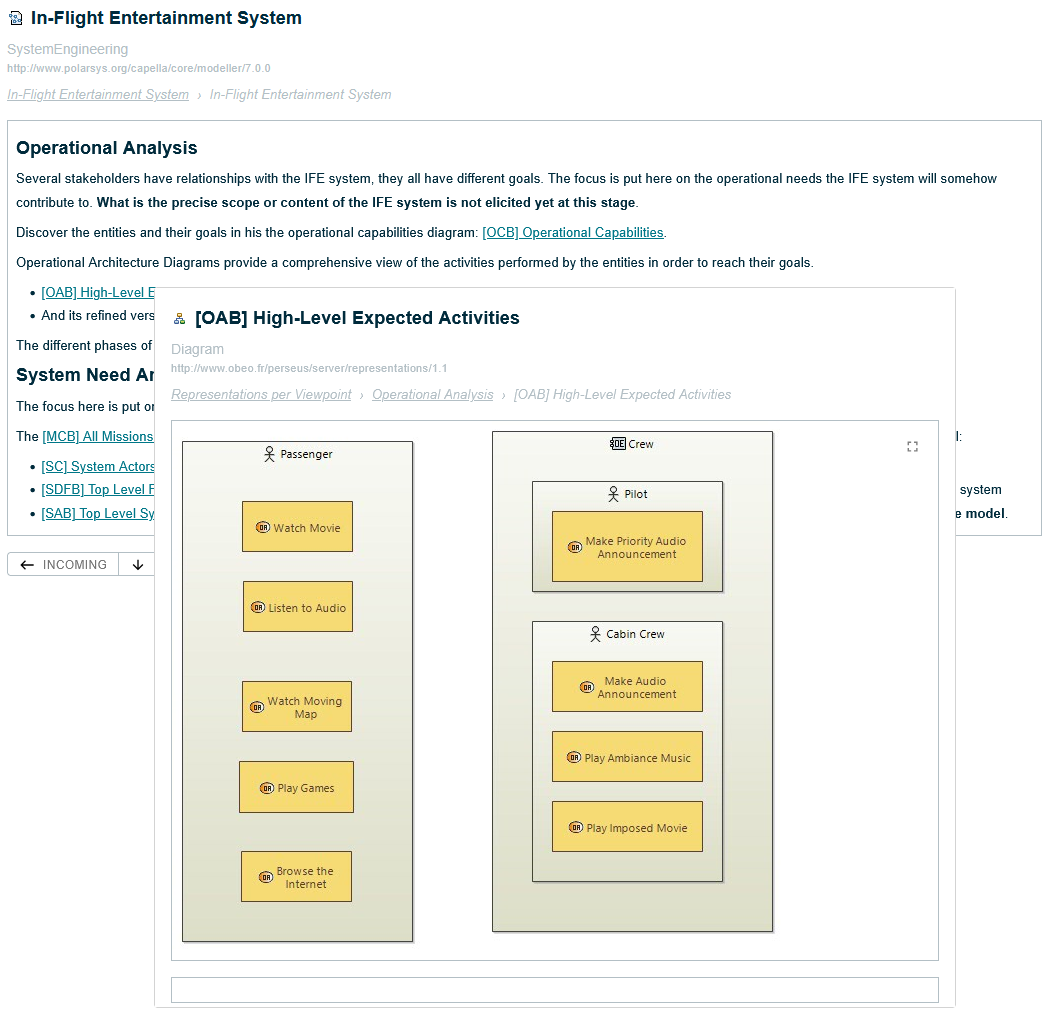
PERS-760- Add previews in rich text descriptions. It is now possible to preview the internal links to diagrams or model elements in the published rich text description of model elements.
-
PERS-770- The default meta-class filter is now better aligned with the default Capella filters so that the model tree are, by default, identical. -
PERS-771- Some diagrams were missing in the semantic model tree, this bug has been fixed.
5.2. Contributor Client Changes
-
PERS-754- Fix undesirable side-effect when traceability is used with Requirements viewpoint. An involuntary interaction between the popular Capella Requirements add-on and Publication For Capella was preventing the display of the artifact to diagram compartment (SeePERS-541below). -
PERS-752- Move URL Mappings from preferences to traceability model. This change makes it easier to share the settings for drag&drop or copy/paste of URLs between team members. -
PERS-747- Fix features metadata. -
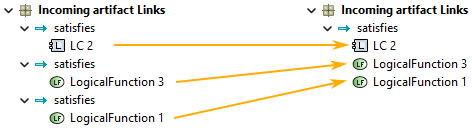
PERS-719- Improve traceability semantic browser integration.
-
PERS-624- Display ID of artifacts in labels.

6. Version 2025.2.2
Hot-fix version to improve OpenID Connect and OAuth-2.0 support especially for opaque access tokens.
6.1. Server Changes
-
PERS-751Support configuration for opaque access tokens and not only JWT access tokens.
6.2. Contributor Client Changes
-
PERS-751Improve use of refresh tokens to avoid too many user interactions for authentication.
7. Version 2025.2.1
Hot-fix version to resolve a bug on the creation of associations with Friends that expose many service providers.
7.1. Server Changes
-
PERS-745Fix bug that prevent the creation of an association with a service provider of a Friend that exposes many service providers. -
PERS-579Add documentation for connecting Publication For Capella with Atlassian Jira. -
PERS-744Make it possible to support several signing algorithms for OpenID Connect.
8. Version 2025.2.0
Publication For Capella is now based on Sirius-Web 2025.1.0 and Obeo Enterprise for Sirius 2024.11.2.
Here are the most interesting improvements:
-
A simple mechanism to prevent some diagrams from being published by simply prefixing their name with
[PRIVATE]; -
The possibility to easily create trace links to diagrams in Capella, which used to be quite difficult;
-
Publication settings have been moved from preferences to the traceability model so that it’s easily shared by all the engineers who work on a model.
Below is a full list of changes brought by this release.
8.1. Server Changes
-
PERS-706- The Publication For Capella server has more options to support more OpenID Connect authentication providers. -
PERS-709- Unauthorized update of consumers has been fixed. -
PERS-710- Unauthorized access to administrator pages has been fixed. -
PERS-722- Updating an existing consumer has been fixed.
8.2. Contributor Client Changes
-
PERS-706- The Publication For Capella contributor client has more options to support more OpenID Connect authentication providers. -
PERS-541- It is now easy to link diagrams to artifacts, either by drag and drop, or by copy/paste.-
Artifacts can be dropped in a diagram background to create a link to this diagram.
-
Artifact URL can be pasted on a diagram background to create a link to this diagram.
-
Artifacts linked to the diagram in which they are displayed show the link in a dedicated compartment.
-
Links to diagrams that were created using previous versions of Publication For Capella will be automatically migrated when updating from the server.
-
This resolves performance issues that may arise with Team for Capella in certain cases.
-
-
PERS-598- It is now possible to filter diagrams on publish, based on a simple naming rule:-
By default, diagrams whose names are prefixed with "[PRIVATE]" will not be published.
-
This prefix is configurable.
-
-
PERS-720- Actions requiring an OAuth2 login can now be cancelled. -
PERS-726- Artifacts can now be dropped in the "Representations per category" folder in the Capella Model Explorer.
9. Version 2025.1.0
Publication For Capella is now based on Sirius-Web 2025.1.0 and Obeo Cloud Platform 2024.11.1. This version brings support for the OpenID Connect protocol to support user authentication.
It also brings an experimental support of CodeBeamer integration through OSLC.
9.1. Server Changes
The Publication For Capella back-end server has undergone many changes to align better with the desired architecture and take advantage of Sirius-Web and Obeo Cloud Platform.
-
PERS-511- It is now possible to log in using OpenID Connect, in addition to the legacy authentication system based on user/password credentials. -
PERS-546- A validation of the publication data is now made by the server before triggering a job. This validation can reject the publication if some link types have been defined in the contributor Client but not in the server. In such a case, the server’s configuration needs to be aligned with the contributor client configuration by creating the missing link types in the OSLC linking configuration. -
PERS-412- Links that point to a delete artifact can now be detected and dealt with. -
PERS-577- Publication For Capella is now compatible with CodeBeamer. The integration with CodeBeamer is achieved based on OSLC and is considered as experimental in this release.
9.2. Web Client Changes
-
PERS-539New options are available on OSLC associations.-
Dialogs can be filtered in the delegated link creation dialog by type (selection or creation).
-
Another option makes it possible to decide whether the delegated link creation dialog must remain open after link creation or not.
-
-
PERS-540Diagrams are now displayed in the semantic model tree. They are still displayed in the 'Representations per Viewpoint', as before. -
PERS-557Properties displayed in the Web client have been improved for many types of Capella objects. -
PERS-576A preview is now displayed when a link to a third-party artifact or a published model element is hovered with the mouse. -
PERS-544A warning is now displayed on model tree nodes when the model contains invalid links
9.3. Contributor Client Changes
-
PERS-518The contributor client can now use OpenID Connect to authenticate with the Publication For Capella server. This change improves security by removing the need to store the user’s credentials on the local machine’s secure store. -
PERS-550The command 'Show online' now opens the diagram page when invoked by right-clicking on a diagram’s background. In previous versions, it used to open the page of the semantic target of the diagram. -
PERS-564An option to refresh diagrams before publishing has been added. -
PERS-565A new way to create traceability links has been added, using copy/paste. First, copy the URL of the third-party artifact in a web browser, then select one model element in a diagram and use Crtl+V to paste it. This will create a traceability link. -
PERS-575The outcome of a Publication is now displayed in Capella to the Capella user when the publication job is over. The user is thus notified if there is a problem or if the publication was OK.
10. Version 2024.05.1
This is a hot fix version released to resolve a bug that prevents large models from begin published. Only the server is impacted, there is no new version of the Contributor Client.
10.1. Server Changes
-
PERS-517A bug preventing large models from being published has been fixed. This bug only impacts release 2024.5.0. Every customer using version 2024.5.0 is invited to upgrade to version 2024.5.1.
| The Contributor Client version 2024.5.0 remains unchanged and is compatible with the Publication For Capella server version 2024.5.1. There is no need to upgrade the Contributor Client when upgrading a Publication For Capella server from 2024.5.0 to 2024.5.1. |
11. Version 2024.05.0
11.1. Server Changes
-
PERS-515Publication For Capella now sets theSecurity-Content-Policyin its response headers so that OSLC friend web sites and white-listed web sites can embed its pages iniframeelements. Refer to Content Security Policy White List for more details. -
PERS-516Publication For Capella now properly displays the OSLC links title even when they contain HTML elements.
11.2. Contributor Client Changes
-
PERS-503Messages displayed when a drag and drop takes place on unsupported element have been improved to better explain why no link is created. -
PERS-504The configuration of the types of links that can be created between Capella elements and third-party artifacts has been improved to make it more simple and more powerful. It is now possible to use super-type names. Refer to Artifact Repositories for more details. -
PERS-505An optionfr.obeo.perseus.ssl.trusthas been added to facilitate the use of the contributor client with self-signed SSL certificates. Refer to Trusting the Publication Server Certificate for more details. -
PERS-512A bug that prevented publishing models with broken links has been fixed. Such links (that have no source or no target) are now ignored but do not block the publication. -
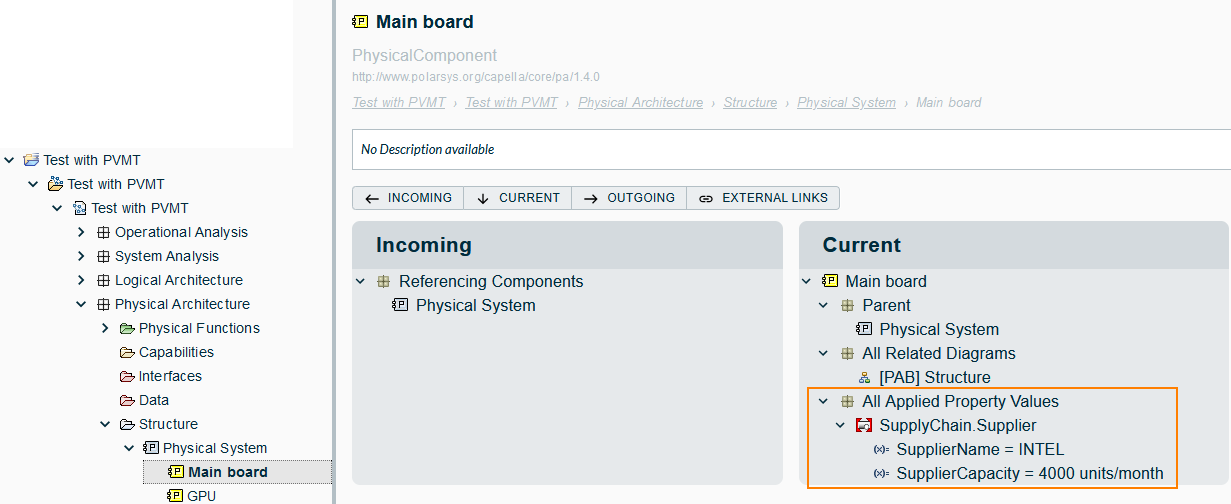
PERS-514A category has been added in the semantic browser to display all the applied property values of an element in a way that is compliant with the PVMT Capella Add-on. When a model is published, this category is also displayed online so that users can easily see which property values are applied to an element.
12. Version 2024.03.0
Version 2024.03.0 brings support for versioning of the model data exposed on the Publication server.
12.1. Server Changes
-
PERS-445A new component that supports storage of model and model objects versions has been introduced. -
PERS-473The default labels for the four IBM DOORS Next link types (trace, satisfy, specify, derives) have been fixed. It is recommended to reflect these changes in server environments in theoslc-linking.jsonfile. -
PERS-476A dependency to Spring’sUriComponentsBuilderhas been removed to fix two recent CVE:
12.2. Contributor Client Changes
-
PERS-445The publication wizard now requires the user to enter a mandatory message explaining the reason of the publication.-
This message is used as a commit message that is displayed online in the model history view.
-
-
PERS-450The credentials to connect to the Publication server will always be requested if they are not properly set in the preferences.
12.3. Web Client Changes
-
PERS-479The web client now displays the history of publications and online link modifications of models. This history is displayed in a dedicated right-hand panel.
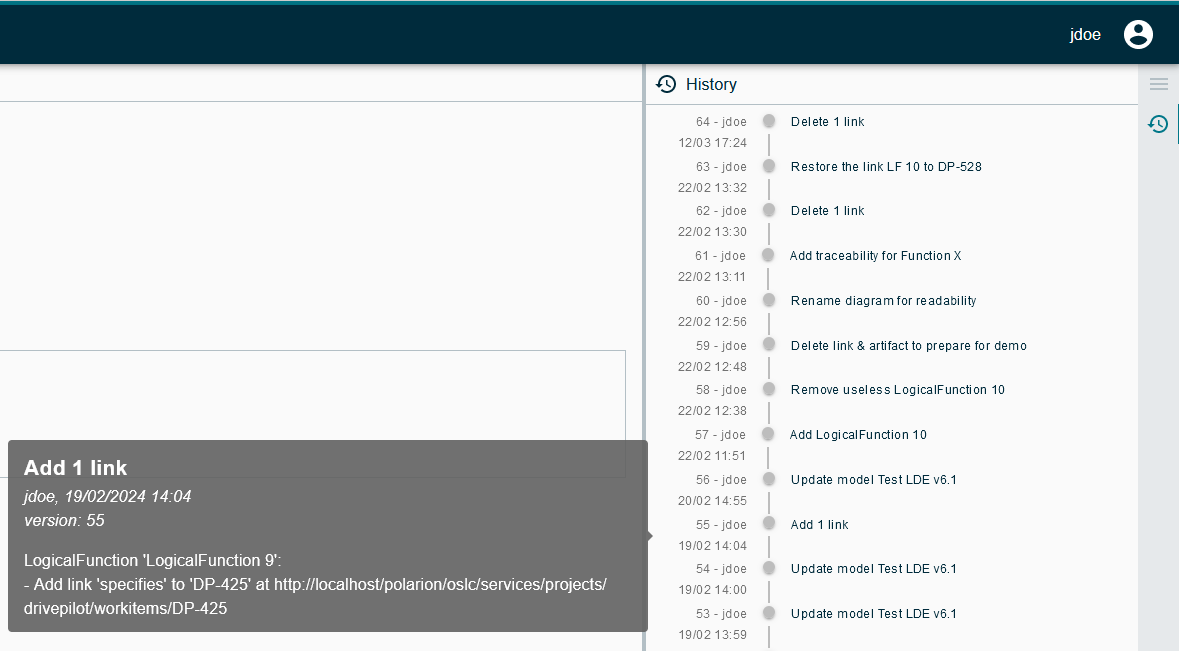
-
PERS-222The quick search no longer reloads the page when a search result is selected. -
PERS-227The quick search now supports navigating in search results using the keyboard arrows.
12.4. Documentation Changes
-
PERS-472Documentation for the configuration of dropped URL mappings in the Contributor Client has been improved with more robust patterns. These patterns make it possible to use the drag and drop feature of Publication for Capella within System Modeling Workbench. -
PERS-477The process to install Publication For Capella in a Team for Capella context has been documented in the installation guide, section Installation in a Team for Capella Context. -
PERS-497A known issue with Team for Capella has been documented and will be fixed in the upcoming version 7.0. See Known Limitations in the Contributor Client for more details. -
PERS-486The URL of Polarion’s web page to validate an OSLC Friend request issued from Publication For Capella has been documented in section Create a new Friend. -
PERS-434A known limitation with High-DPI displays has been documented in section Contributor Client Known Limitations.
13. Version 2023.12.0
13.1. Server Changes
-
The property
perseus.oslc.linking.globalhas been renamed toperseus.oslc.linking.default. Make sure to change this property’s name in your ownapplication.propertiesfile accordingly.
13.2. Contributor Client Changes
-
PERS-425Facilitate the reuse of a Traceability Configuration: It is now possible to export and import a traceability configuration in Capella, making it easier to configure a new Capella project for traceability with third-party repositories. Refer to Import / Export Traceability settings for more details. -
PERS-438The publication URL of a given Capella model is now stored in the*.traceabilityfile instead of the*.airdfile. In some cases, users will be prompted for a choice when they open their Capella model after upgrading to the latest version of the Publication For Capella Contributor Client add-on. -
PERS-429Support Global Configuration Management-
There is now an initializer to create the OSLC Configuration Management domain. This initializer must be run if the model needs to use a Global Configuration.
-
Whenever a model is configured for a specific Global Configuration, then only artifacts compliant with the Global Configuration can be dragged and dropped from third-party repositories.
-
13.3. Web Client Changes
-
PERS-429Support Global Configuration Management:-
A project can now be set-up to use Global Configuration if connected to an IBM Jazz Team Server.
-
Within such a project, all models must be associated to exactly one Global Configuration to support traceability.
-
Refer to section Global Configuration Support in the user guide for more details.
-
14. Version 2023.10.0
14.1. Contributor Client Improvements
-
PERS-413The traceability initializer now provides an initializer for the JTS domain 'LinkTypes'.
14.2. API Improvements
-
PERS-394OSLC queries now support "where *=<perseus_url>". -
PERS-395OSLC queries now support "in [<perseus_url>]". -
PERS-407Model object data retrieval via OSLC API has been optimized.
14.3. Bug Fixes
-
PERS-199OSLC links created from another tool to an unnamed object in Publication For Capella are now navigable. -
PERS-410It is now possible to create OSLC links from an unnamed object in Publication For Capella. -
PERS-398Fix incorrectly encoded characters in OSLC query results. -
PERS-399Limit access to OSLC Catalogs according to the user’s permissions. -
PERS-357- Contributor Client - Fix counting of model elements when publishing. -
PERS-409- Contributor Client - Fix missing links issue in some Capella diagrams. -
PERS-423- Contributor Client - Fix NullPointerException when trying to publish a model with broken representation descriptions.
15. Version 2023.8.0
15.1. Server Improvements
-
PERS-377- Proxies are now supported in the server. Refer to the installation guide for more details.
15.2. Web Client Improvements
-
PERS-371- The labels of OSLC Link types are now properly displayed in the OSLC Links panel, taking into account the OSLC Linking Configuration.
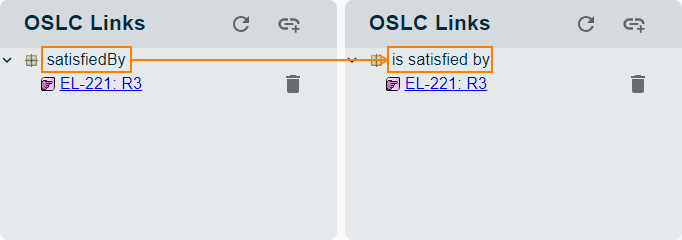
-
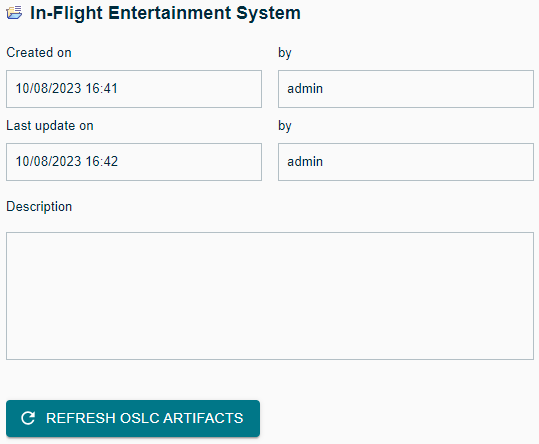
PERS-364- Web Client - The 'refresh all artifacts' action is now accessible to all the project contributors.-
Previously, this action was only available to the server administrator. This was wrong because most of the time the server administrator has no account on the registered OSLC Friend servers, especially when P4C is deployed in a cloud environment.
-
-
PERS-347- Miscellaneous UI Improvements:-
A link "back to consumer’s list" has been added on all OSLC Consumer pages.
-
A link "back to project" has been added to the project settings page.
-
It is now possible to rename OSLC Friends.
-
15.3. Contributor Client Improvements
-
PERS-377- Proxies are now supported in the Contributor Client. Refer to the installation guide for more details. -
PERS-367- The traceability layer is now automatically activated whenever an artifact is dropped in a diagram. -
PERS-359- Links created from remote consumer servers are now synchronized with Capella, as long as there is a correct configuration making it possible for the Publication server to access this consumer as an OSLC Friend.
15.4. API Improvements
-
PERS-383- Miscellaneous OSLC API Improvements (Refer to OSLC API for more details):-
The amount of information available in the RDF representation of model elements is now richer. It includes all the properties and references of the model elements.
-
The OSLC Query API now supports more types of queries.
-
15.5. Bug Fixes
-
PERS-381- Web Client - Links with no reverse link type can be properly created, which is absolutely necessary for compatibility with DOORS Next.-
Previous version had a regression that caused such links to be wrongly marked as problematic.
-
-
PERS-376- Using the Capellatemplatepatternsmeta-model is now supported.-
Previously, trying to publish models that depend on this meta-model was prevented by a 'Constraint Violation' exception.
-
-
PERS-373- The order of viewpoints in 'Representations per viewpoint' in the Web Client is now identical to what it is in Capella, even when additional viewpoints are used. -
PERS-372- Minor differences regarding the labels of Viewpoint Categories in the Web Client model tree have been fixed. -
PERS-368- Web Client - The licensing enforcement mechanism will now properly ignore inactive accounts. -
PERS-367- Contributor Client - Artifacts are now properly displayed in unsynchronized diagrams.-
Previously, a bug was causing artifacts to be displayed without their type and text in unsynchronized diagrams.
-
-
PERS-360- Web Client - The web client will no longer fail if access to the browser’s local storage is denied. -
PERS-378- Contributor Client - Closing the Publication For Capella preferences dialogs no longer causes an exception to appear in the error log.
16. Version 2023.4.0
The focus of this version is on user experience improvements.
16.1. Java version
The server now requires Java 17.
16.2. Web Client Improvements
-
The search treats '%' and '_' as any other characters, making it possible to search for the an exact chain containing one of those.
-
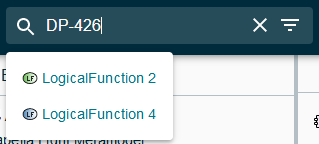
OSLC link targets and their OSLC identifier are included in the search scope.
-
Consequently, it’s now possible to locate model elements linked to an artifact 'ART-ID' by simply searching for
ART-ID.
-
-
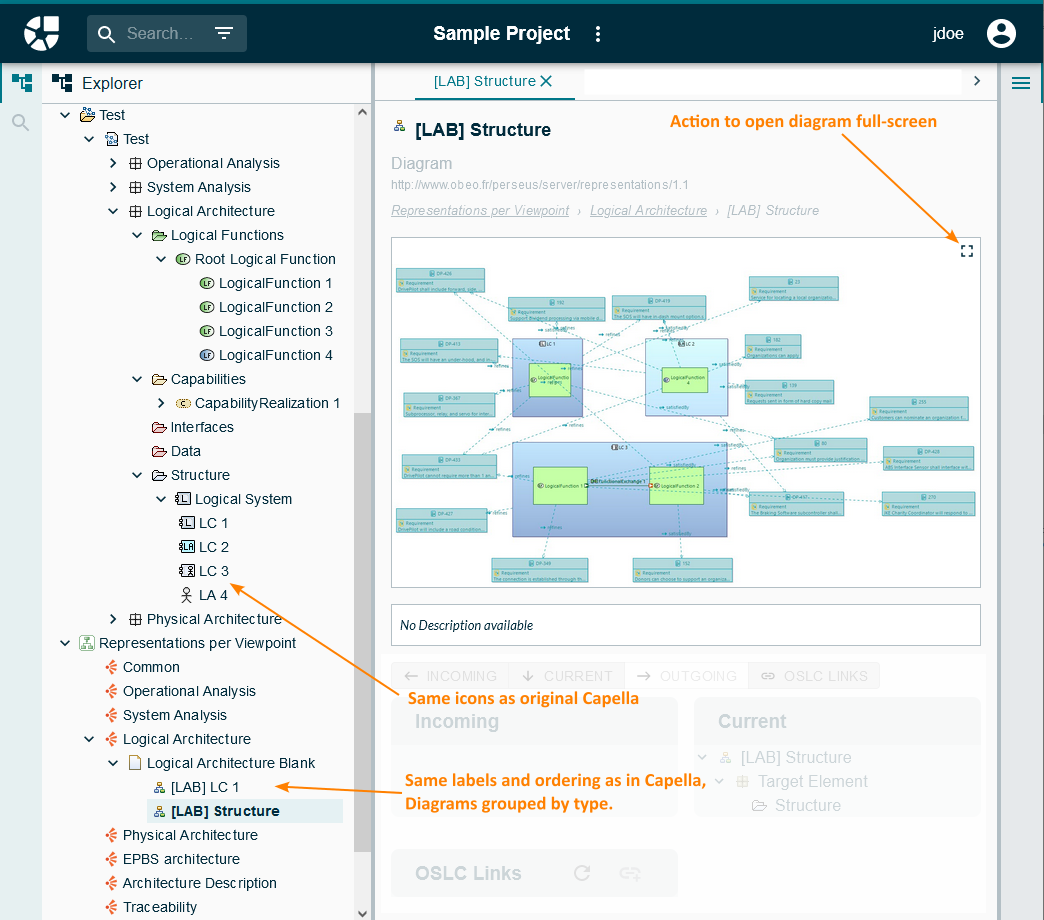
Capella models and model elements are displayed with the same icons as within Capella.
-
The labels of the Viewpoints and their ordering is now identical to what they are in Capella.
-
Representations are grouped by type in the explorer tree, just like in the Capella explorer.
-
The Model Tree nodes are now properly aligned, no matter whether they have children or not.
-
Diagrams are scaled to the browser size. More specifically, diagram images are scaled down if they exceed the available width of the available area.
-
An action makes it possible to display diagrams in full screen.
-
When in full screen, it is possible to grab the whole diagram with the middle mouse button to move it easily.
-
-
Representation Notes in diagrams can now be clicked to navigate to their target diagram.
-
Clicking on objects in diagrams that have other representations attached makes it possible to access those representations.
-
The jobs page now refreshes automatically.
-
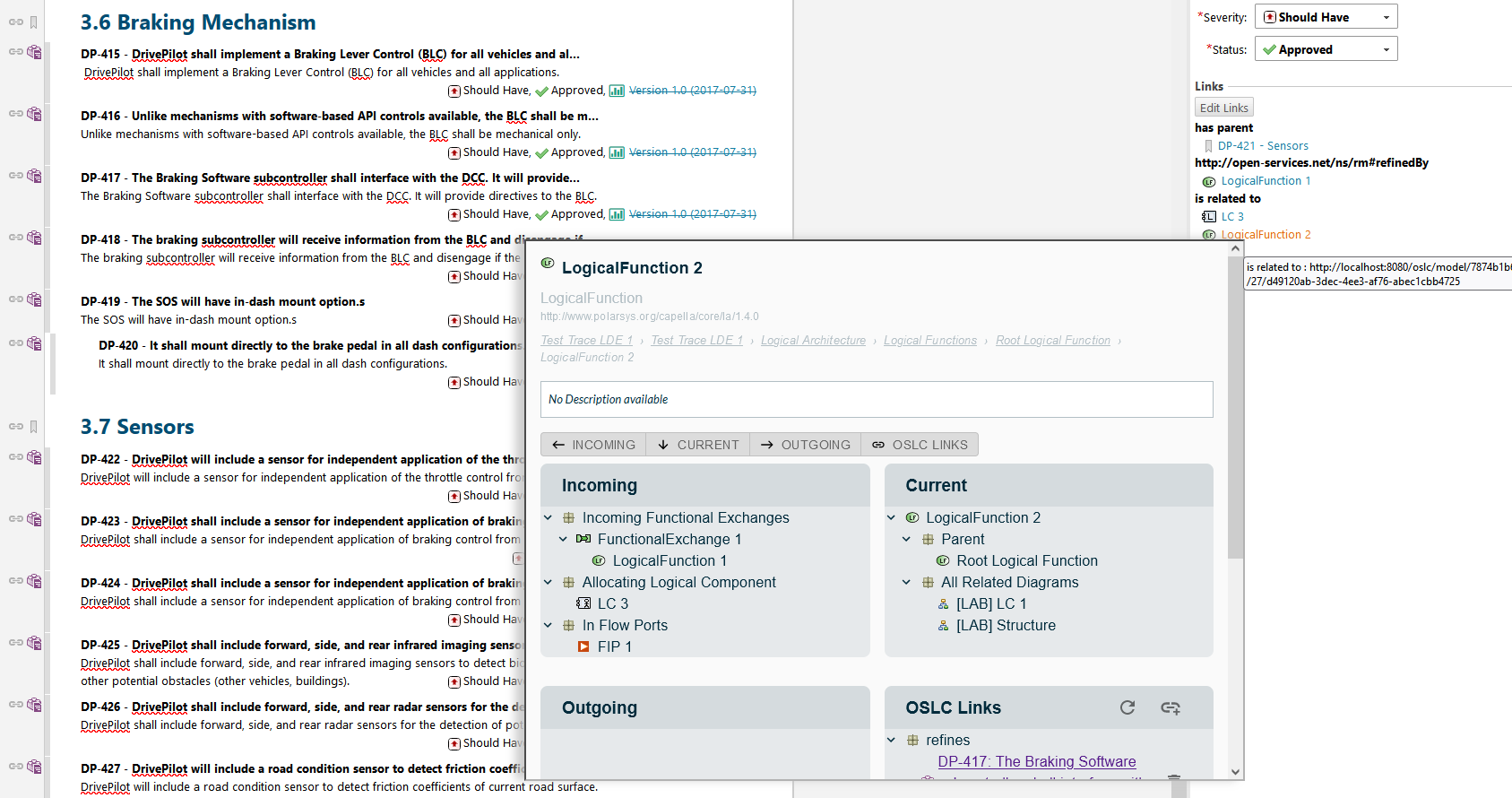
OSLC 'small' preview is now supported, which consequently makes it possible to have the OSLC preview being displayed by Polarion for links targeting Capella model elements in Publication for Capella.
16.3. Contributor Client Improvements
-
At the end of a publication the jobs page is no longer automatically opened. A pop-up with a hyperlink leading to the jobs page is now displayed instead.
-
Updating from the server only considers friends that have been configured as Artifact Repositories within the Traceability model.
-
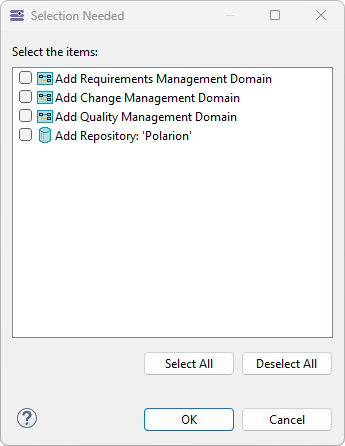
The "Init traceability" action now only displays domains that are not already configured in the model.
-
The "Init traceability" action now displays icons for each initializer.
-
A new kind of initializer is available to facilitate the creation of Artifact Repositories in the model by retrieving available friends from the Publication server.
16.4. Bug Fixes
-
A bug prevented very large models from being published (when the amount of bytes to publish exceeded the largest Integer value in java). This has been resolved, making it possible to publish very large models. However, the RAM and disk space must be sufficient to hold the published data in memory and in the temporary folder used by java, which is system dependent.
17. Version 2023.3.1
The version is mainly a bug-fix release, with a few improvements related to the IBM Jazz suite support.
17.1. Improvements
-
Connectivity from Publication for Capella to Jazz EWM and Jazz Quality Manager is now supported.
-
In previous versions, only DOORS Next could be connected from Publication for Capella.
-
-
Consequently, drag & drop from Jazz EWM is now supported.
| Drag & drop from Jazz Quality Manager is still not supported. |
17.2. Documentation Improvements
-
Examples of configurations for Jazz EWM and Jazz Quality Manager have been added, both for the server OSLC Linking configuration and for the Contributor Client configuration.
17.3. Contributor Client Bug Fixes
-
Diagrams are now properly refreshed when artifacts are dropped, even in Team for Capella.
-
The Contributor Client no longer hides meta-model registration errors.
-
There was a bug in previous versions that could hide a meta-model registration error and let the publication proceed, resulting in an error message 'meta-model with hash xxxx is not registered'.
-
-
Models with invalid views can now be published.
-
There was a bug in previous versions that prevented some models from being published. Specifically, the models with views with no viewpoint set could not be published.
-
17.4. Server Bug Fixes
-
The regression that caused deleted links to still appear in DOORS Next is now fixed. This regression had been introduced in version 2023.3.0.
18. Version 2023.3.0
The main novelty of this version is the capability to manage traceability links directly within Capella, while keeping these links synchronized with the Publication server and the connected third-party repositories.
18.1. Managing Traceability in Capella
This new capability makes it possible for System Engineers to easily create traceability links between their model elements and third-party artifacts such as requirements, tests cases, or change requests.
The System Engineer can create such links simply by dragging and dropping URLs of artifacts from their website into Capella.
The drag and drop can take place in a diagram, or in the model tree. A link gets created between the dropped artifact and the model element on which it was dropped.
It is possible to configure different types of links to be created between different types of model elements and different types of artifacts. If several types of link are configured as being allowed between the dropped artifact and the model element, then the user must chose the one they want to create.
These links are available within the Capella model, but they also get to the Publication server each time the model is published. These links can also be created or deleted on the Publication for Capella website, and System Engineers can synchronize their Capella models to retrieve these link changes in the Capella model.
Please refer to the User Guide for a complete description of this novelty and the related features.
18.2. Other Changes
-
Models must be saved before publishing.
-
A pop-up will be displayed if the user tries to publish an unsaved model to make it possible to save the model and proceed, or cancel the publish.
-
-
Models are automatically saved after publishing.
-
Publishing a model will modify some technical information in the model. For this reason, the model is saved automatically after publishing, whereas it appeared as dirty in previous releases.
-
18.3. Bug Fixes
-
The display of the rich text documentation is now correct.
-
There was a bug in previous versions that caused the rich text to be incorrectly formatted after the 1st link in the documentation.
-
-
The version number displayed in the home page footer is now correct;
-
In version 2022.11.0, the footer was incorrect and stated '2022.9.0'.
-